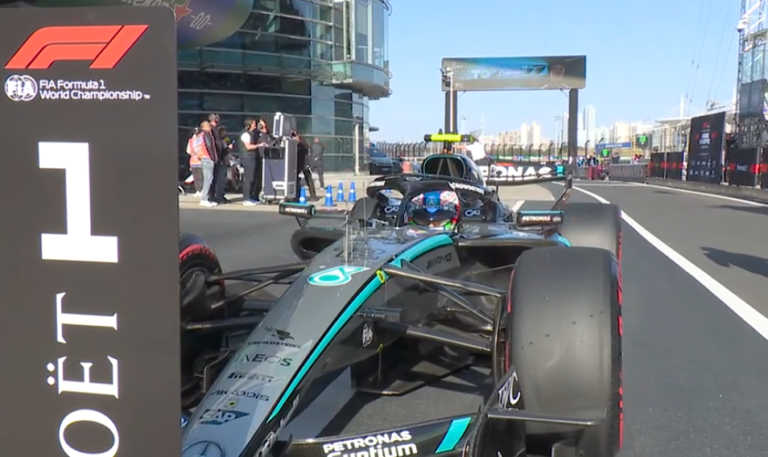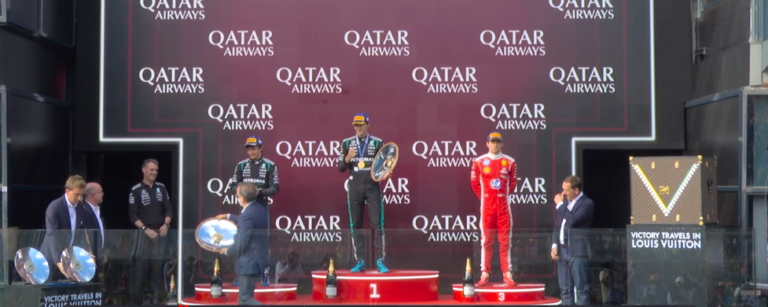
It is the most statistically dominant team of the 21st century. It was built from a factory Honda walked away from in December 2008. The car that started it all was bought for £1. The championship it won in its debut year has never been replicated. Then came eight consecutive constructors' titles, seven drivers' titles, and the longest sustained dominance in the history of the sport. Then four years of a misguided concept, a failed gamble, and a slow rebuild. The team that arrives at the 2026 regulation reset is different in composition from the one that won the last of those eight titles in 2021. Whether it can use the power unit era it helped create to win a ninth is the question that defines its current chapter.
| Full name | Mercedes-AMG Petronas Formula One Team |
| Headquarters | Brackley, England (chassis); Brixworth, England (power unit) |
| Racing licence | German |
| Ownership | Toto Wolff (33%), INEOS (33%), Mercedes-Benz AG (33%) |
| Team principal | Toto Wolff |
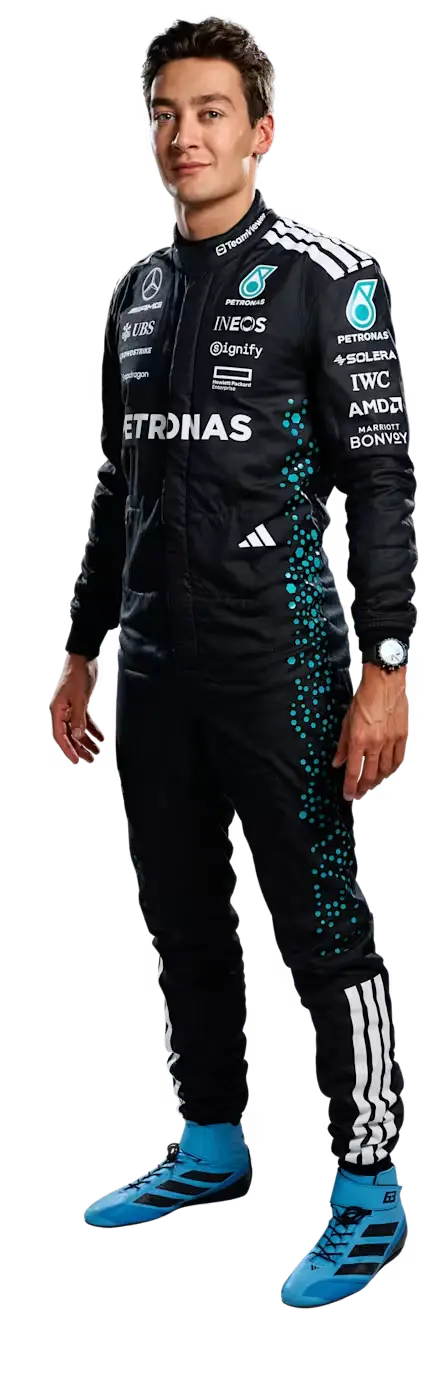
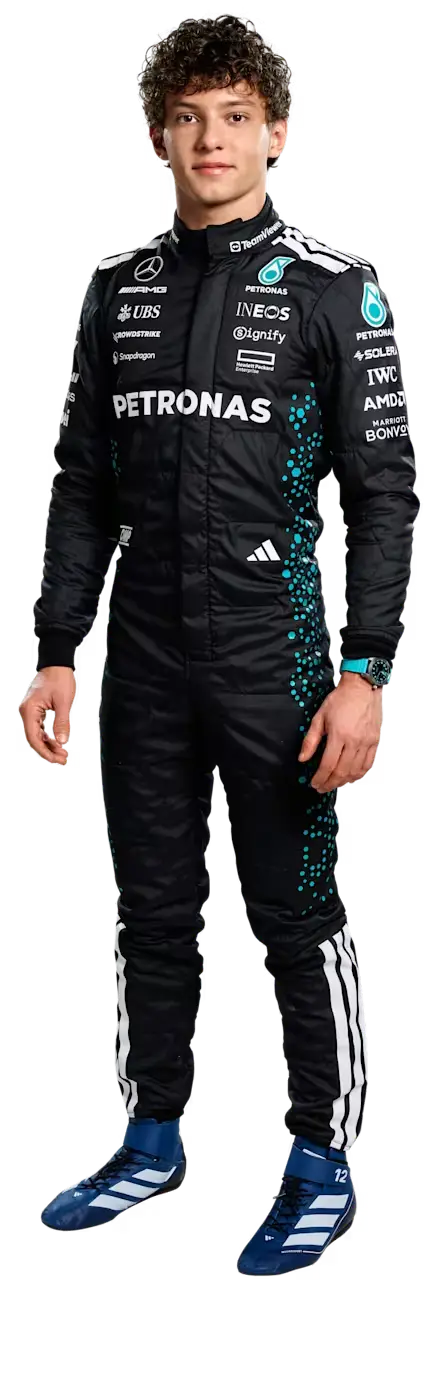
| Drivers (2026) | George Russell, Kimi Antonelli |
| Power unit (2026) | Mercedes-AMG |
| Constructors' Championships | 8 (2014–2021) |
| Drivers' Championships won | 7 consecutive (2014–2020); Hamilton 6, Rosberg 1 |
| Race wins | 125+ |
The team's entry into Formula One traces back to Ken Tyrrell, who began his motorsport operation in 1958 and entered Formula One in 1968. Tyrrell Racing won the Constructors' Championship and three Drivers' Championships in the 1970s with Jackie Stewart behind the wheel. The operation ran until 1998, when declining results led Tyrrell to sell the team's entry to British American Tobacco, which transferred it to a new constructor called British American Racing, or BAR, in 1999.
BAR formed a partnership with Honda's engine programme, peaked with second place in the 2004 constructors' championship, and became the Honda Racing F1 Team when Honda acquired full ownership in 2006. Despite substantial Japanese investment, the team struggled for sustained competitiveness. The situation deteriorated dramatically in December 2008 when Honda's president Takeo Fukui held an emergency press conference and announced the company's complete withdrawal from Formula One, citing the global financial crisis triggered by subprime loans. Several hundred employees at the team's Brackley factory faced an uncertain future.
The team was saved by a single person's credibility. Ross Brawn had joined Honda's operation in late 2007 after stints as technical director at Benetton and Ferrari, having won seven Constructors' Championships across those roles. He saw in Honda's upcoming 2009 car a genuine opportunity: the regulations were changing substantially, and the car had been developed with those changes as the primary target.
When Honda announced its withdrawal, Brawn spent the winter attempting to find a buyer for the team. He failed. With time running out, he and CEO Nick Fry led a management buyout. Honda's motorsports managing officer, Hiroshi Oshima, agreed to the sale for a symbolic £1. Oshima later said: "I trust Ross very much, so if Ross is there, I can sell the team to him." Honda provided a $100 million budget to cover the 2009 season, equivalent to the redundancy costs it would have faced closing the factory and the team was renamed Brawn GP on 6 March 2009, three weeks before the opening race in Australia.
There was still no engine. Multiple manufacturers offered supply. The Mercedes-Benz unit best fitted the existing design, and a customer deal was agreed. The team worked around the clock, splitting shifts across 24 hours to shoehorn the new engine into a car already far advanced in development.
The BGP 001 arrived in Australia with one significant structural advantage that the rest of the paddock had not anticipated: a double diffuser, designed by junior aerodynamicist Masayuki Minagawa, which exploited a loophole in the new aerodynamic regulations to generate substantially more downforce from the rear of the car than the conventional interpretation allowed. At the opening race in Melbourne, Brawn GP took pole position and second in qualifying. Mechanics stood in front of the rear of the car in the garage to prevent rival teams from inspecting it. Button and Barrichello finished first and second in the race.
Button won six of the first seven races of the season. As rivals scrambled to develop their own versions of the double diffuser, the advantage compressed, but Brawn GP had built enough of a championship lead to survive. Button won the Drivers' Championship at Brazil. The team won the Constructors' Championship. In its only season of competition, Brawn GP achieved a 100% championship success rate, winning both titles, making it the first and only team in Formula One history to achieve this. The team received the Laureus World Sports Award for Team of the Year in 2010.
In November 2009, Daimler AG and Aabar Investments purchased a 75.1% stake for approximately £110 million. The team was rebranded Mercedes GP for 2010. In its single year, Brawn GP had generated a profit of £98.5 million. The factory, the workforce, and the technical structure that Brawn had kept alive were now the foundation of a works Mercedes Formula One team.
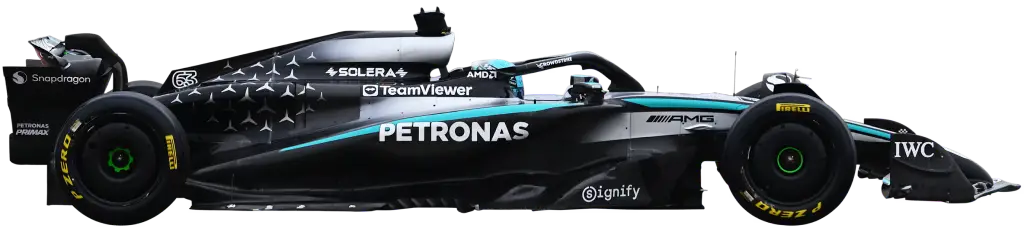
The Silver Arrows name did not begin in 2010. It began in 1934 at the Nürburgring, when the Mercedes W25 arrived for the German Grand Prix painted white according to the regulations of the time. When the car was weighed in, it was slightly over the 750kg limit. The team scraped the white paint off overnight, leaving the bare aluminium body exposed. The car was silver by race day. The name has been used for every Mercedes Grand Prix car since.
Juan Manuel Fangio won the world championship in 1954 and 1955 in the Silver Arrows, the most dominant seasons the sport had seen. Then, at Le Mans in 1955, Pierre Levegh's Mercedes was launched into the main spectator area after contact during the race. Levegh and 83 spectators were killed. Mercedes withdrew from all motorsport competition immediately and did not return as a constructor for 57 years.
The 2012 Chinese Grand Prix, Nico Rosberg's victory, was the team's first as a works constructor in those 57 years. It was also the first time a German driver had won a Grand Prix in a German car since Hermann Lang's victory at the 1939 Swiss Grand Prix.
Torger Christian Wolff was born on 12 January 1972 in Vienna, Austria. His father was diagnosed with brain cancer when Wolff was eight years old and died during his adolescence. He was educated at the Lycée Français de Vienne, learning German, English, and French. He began a motorsport career in Austrian Formula Ford in 1992 and won the Nürburgring 24 Hours in his category in 1994, but recognised relatively early that his future was in business rather than the cockpit.
In 1998, he founded an investment company called Marchfifteen. In 2004, a second, Marchsixteen. He invested in Williams F1 in 2009 and became executive director in 2012, the year Williams took its most recent race win to date with Pastor Maldonado at the Spanish Grand Prix. His operational success there attracted the attention of Daimler board member Wolfgang Bernhard, who asked Wolff to analyse where Mercedes was falling short as a constructor. The analysis led to a job offer.
In January 2013, Wolff joined Mercedes-AMG Petronas as managing partner and team principal, acquiring a 30% stake in the team. Niki Lauda, the three-time world champion, joined simultaneously as non-executive chairman with a 10% stake. Their relationship was explicitly complementary: Wolff drove the internal architecture, accountability systems, data culture, organisational growth, recruitment, while Lauda provided the experienced racing voice that drivers trusted and rivals respected. Wolff described the combination as essential.
The staff headcount was around 650 when Wolff arrived. By 2022 it was approximately 1,300. Annual turnover roughly doubled to around $450 million across the same period.
In 2004, at a Formula 3 test in Valencia, a young Lewis Hamilton walked into the garage of a rival team to ask about their cars. Wolff, who was managing a driver at that test, noticed the curiosity immediately. The two did not work together professionally for another nine years. When Hamilton's contract with McLaren ended in 2012 and Mercedes needed a driver to replace Michael Schumacher, the memory of that Valencia afternoon was not irrelevant.
Hamilton signed with Mercedes for 2013, replacing Schumacher, who had returned from retirement in 2010 and driven three seasons without winning a race. The signing was widely considered a risk, the Mercedes car at that point was not in the front-running tier, and Hamilton was exchanging a McLaren with a proven competitive record for a project that was still developing. What both Hamilton and Wolff understood was that 2014 was the more important year: the regulations were changing to hybrid power units, and Mercedes had been developing its powertrain in partnership with the Brixworth engine facility for years.
The turbo-hybrid regulations introduced in 2014 produced the most consequential competitive shift in Formula One since the ground-effect era. Mercedes' power unit, developed at Brixworth under what had formerly been the Ilmor Engineering facility, was significantly more powerful and more fuel-efficient than the equivalent units from Renault and Ferrari. The margin was large enough in 2014 that Hamilton and Rosberg were fighting only each other for the championship from the season's opening rounds. Hamilton won the 2014 Drivers' Championship. The Constructors' title followed.
Between 2014 and 2021, Mercedes won eight consecutive Constructors' Championships, breaking Ferrari's previous record of six consecutive titles between 1999 and 2004. They won 118 of 252 races in the turbo-hybrid era under Wolff's leadership. Hamilton took six Drivers' titles in that period; Rosberg took one.
The relationship between Hamilton and Nico Rosberg was one of the most productive and most damaging in the team's history simultaneously. The two had been karting rivals as children. At Mercedes they were equal machinery, equal support, and entirely unequal temperamentally. Their rivalry produced outstanding racing: collisions at Spa in 2014, at the start of the 2016 Austrian Grand Prix, simmering tension throughout. Rosberg won the 2016 Drivers' Championship on the final day of the Abu Dhabi season finale, the last race of the year and a title fight that went to the final lap.
Five days later, Rosberg announced his immediate retirement from Formula One. He had achieved his goal. He left. The team replaced him with Valtteri Bottas, who was asked explicitly to serve a more supporting role alongside Hamilton. Bottas drove well and won races, but the dynamic was understood by everyone in the garage.
At the 2020 Turkish Grand Prix, Hamilton equalled Michael Schumacher's all-time record of seven world championships. He was 35. The following year, over 22 races, he fought Verstappen in what became the closest championship battle since 2008. Hamilton was faster in Abu Dhabi at the season finale. He was leading on the final lap with fresh tyres when the safety car was deployed for a crash. Race director Michael Masi permitted five lapped cars between Hamilton and Verstappen to rejoin behind the safety car rather than all lapped cars, contravening Article 48.12 of the sporting regulations. Verstappen, on fresh tyres, passed Hamilton on the restart on the final lap. Hamilton did not publicly attend the post-season prize-giving ceremony. Masi was removed as race director.
When Formula One introduced ground-effect aerodynamic regulations in 2022, Mercedes arrived with a car unlike anything else on the grid. The W13 had almost no sidepods just minimal air inlet channels either side of the cockpit. Technical director Mike Elliott had developed what became known as the "zero-pod" concept. In wind tunnel simulation, the car generated exceptional levels of downforce, and internal reports suggested the approach could be transformative.
When the car ran in the real world, it bounced violently. The largely exposed floor area, which was the core of the concept's aerodynamic philosophy, made the car exceptionally sensitive to porpoising, the rhythmic bouncing at speed caused by ground-effect cars running too close to the track surface. Wolff acknowledged the mechanism publicly at the Miami Grand Prix, noting that the floor edges of the Mercedes "stick out much wider than anybody else's, that gives it a different way, or much more scope, of possible instability." The team raised the car's ride height to manage the bouncing, which sacrificed the downforce the concept had been designed to generate.
Despite the evidence against the concept, Mercedes persisted with it through 2022 and into 2023. The partial justification was George Russell's dominant win at the Brazilian Grand Prix in November 2022, which gave the team a false signal that the direction remained viable. The 2023 season dispelled that. Mercedes did not win a race in 2023, their first winless season since 2011. They finished second in the constructors' championship that year, but it was a distant second to Red Bull, who won 21 of 22 races.
The zero-pod concept was abandoned mid-2023 at the Monaco Grand Prix with the introduction of a more conventional sidepod design. Mike Elliott swapped roles with James Allison, who had previously served as technical director until 2021, before leaving the team entirely. Allison's return to the technical director seat in 2023 represented the clearest signal that the team was acknowledging the previous direction had been a failure.
The 2024 W15, developed under Allison's returned leadership, was a genuinely improved car. Russell won in Austria. Hamilton won at the British Grand Prix in what would be his final season with the team after twelve years. The team won four races across the year. Despite the recovery, they finished fourth in the constructors' championship as McLaren and Ferrari operated at a higher consistent level.
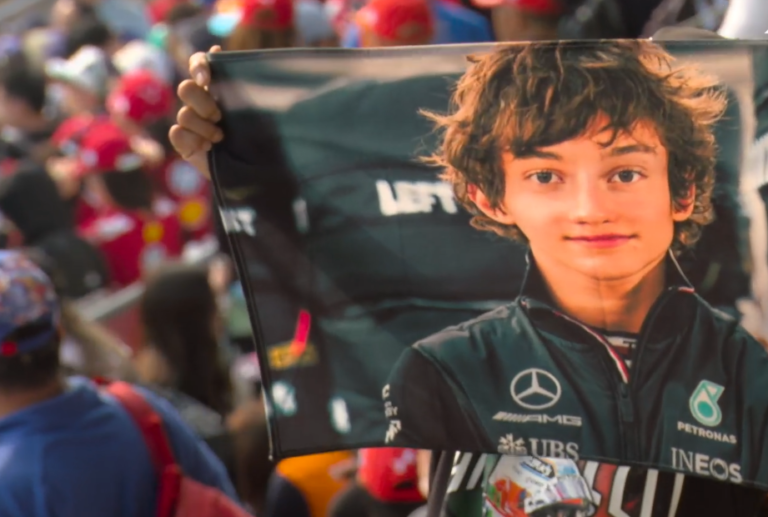
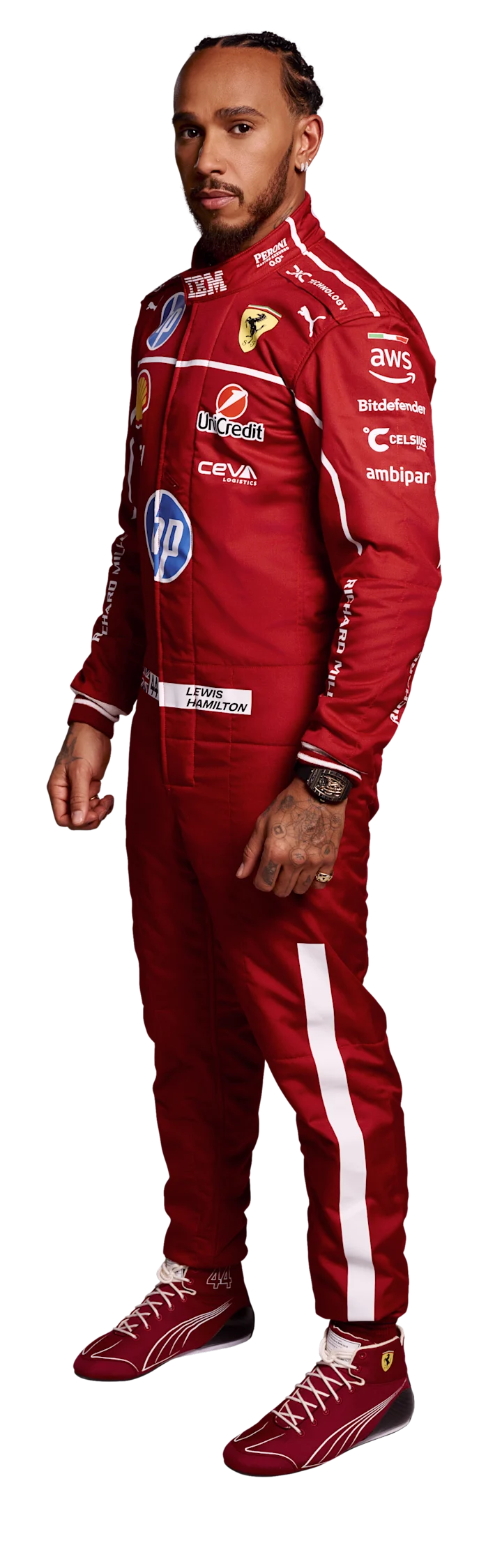
In February 2024, Lewis Hamilton announced he would leave Mercedes at the end of the season for Ferrari. The decision was his. He had won six championships in silver and was drawn to the challenge of what might be his last competitive years in the famous red. Wolff confirmed the signing publicly at the season's opening round. Kimi Antonelli, 17 years old and a product of the Mercedes junior programme, was named as his replacement for 2025.
In his debut season, Antonelli scored points from his first races and consistently contributed across the year. Russell won races. The team finished second in the constructors' championship-its best result since 2021. The four-year wilderness ended not with a title but with a credible, competitive season that demonstrated the technical rebuild under Allison had translated into pace.
The 2026 regulations represent the most significant change in Formula One's technical rules in over a decade. The power unit architecture shifts substantially toward electrical energy, with the electrical motor contributing approximately 50% of total power alongside the internal combustion V6. For Mercedes, as the works power unit manufacturer that has supplied its own team and customer teams including Williams, Aston Martin, and McLaren, the power unit regulations are the area of greatest potential competitive advantage.
Wolff has described his position with characteristic directness: "I'm never confident. I'm a glass-half-empty person, so we'll just do everything we can that is in our power to come out with a car, with a power unit that is competitive enough to fight for a world championship."
The team enters the season with an established pairing in George Russell and Kimi Antonelli, a new W17 chassis, and new sustainable fuel developed by PETRONAS, whose partnership with the team was renewed in a multi-year deal announced in September 2022. Niki Lauda is no longer there. Hamilton is no longer there. The structure Wolff built between 2013 and 2021 has been substantially rebuilt in the three years since. Whether the Silver Arrows can recapture the frequency of winning they achieved between 2014 and 2021 is a question only the season can answer.
| Years | Constructors' | Drivers' Champion | Notes |
|---|---|---|---|
| 2010 | 4th | — | First season as Mercedes GP |
| 2011–2013 | 5th, 4th, 3rd | — | Building under Brawn, then Wolff |
| 2014 | 1st | Hamilton | First hybrid-era title |
| 2015 | 1st | Hamilton | |
| 2016 | 1st | Rosberg | Rosberg retired 5 days after title |
| 2017 | 1st | Hamilton | |
| 2018 | 1st | Hamilton | |
| 2019 | 1st | Hamilton | Sixth consecutive double |
| 2020 | 1st | Hamilton | Record 7th title for Hamilton |
| 2021 | 1st | Verstappen (RBR) | Drivers' title lost Abu Dhabi |
| 2022 | 3rd | — | Zero-pod failure |
| 2023 | 2nd | — | First winless season since 2011 |
| 2024 | 4th | — | 4 wins, W15 recovery |
| 2025 | 2nd | — | Best result since 2021 |
| 2026 | In progress | — | Russell, Antonelli |
All-time records: 8 Constructors' Championships (2014–2021) · 7 consecutive Drivers' Championships (2014–2020), both all-time records · 125+ race victories
Last updated March 2026