The newest team in Formula One is also the most expensive entry in the sport's history. It was built twice: once by a man whose name is no longer on it, and once by a car company that was told it would never race. It represents the completion of a dream that took nearly five years, a congressional investigation, a transatlantic legal threat, and an $450 million cheque. Its first car is named after a man who won the world championship in 1978 and was told the paddock he helped build would not admit an American team in 2024. That team is now on the grid.
| Full name | Cadillac Formula 1 Team |
| Racing licence | American |
| Headquarters | Fishers, Indiana, USA |
| UK base | Silverstone, England |
| Technical base | Fishers, Indiana / Silverstone |
| Engine facility | Concord, North Carolina |
| Team principal | Graeme Lowdon |
| CEO | Dan Towriss (TWG Motorsports) |
| Founder | TWG Global / General Motors |
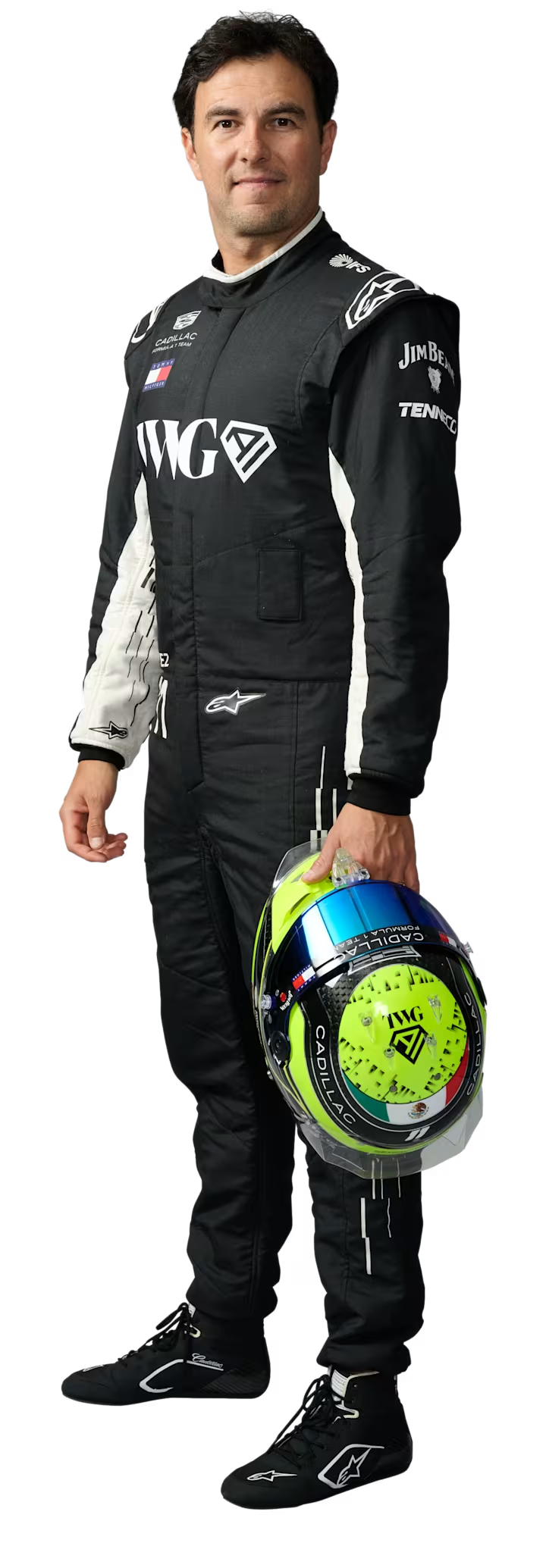
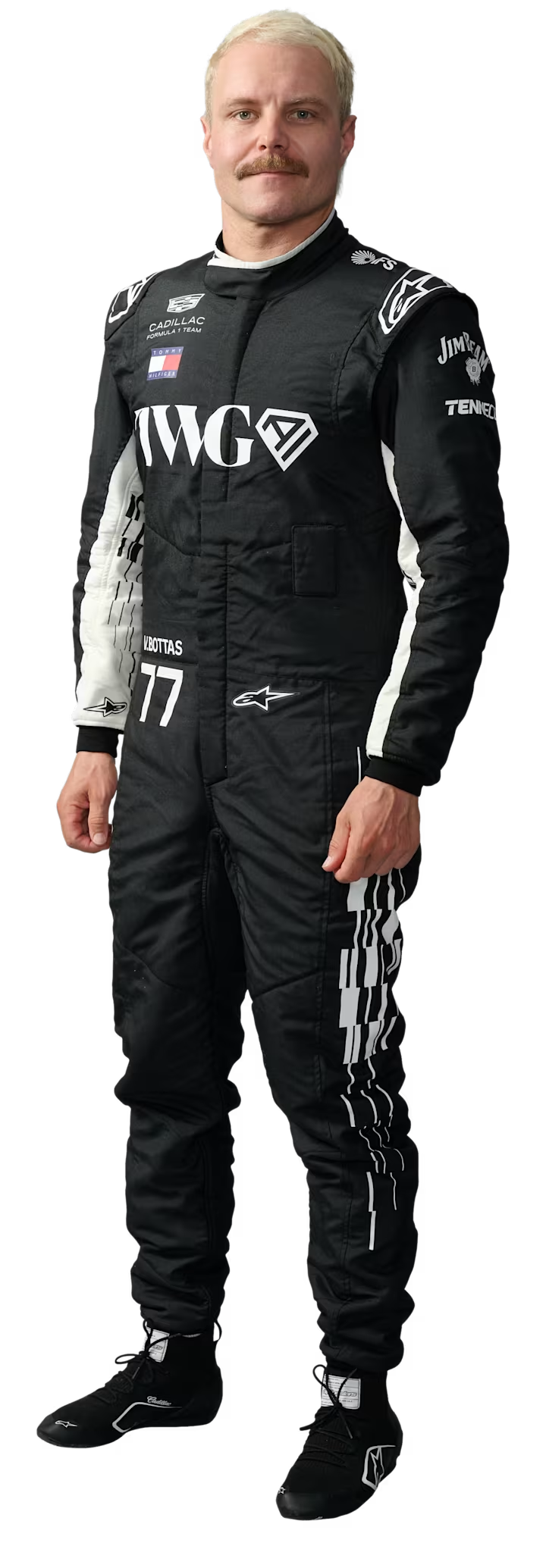
| Drivers (2026) | Sergio Pérez, Valtteri Bottas |
| Reserve driver | Zhou Guanyu |
| Test driver | Colton Herta |
| Power unit | Ferrari (2026–2028); GM (from 2029) |
| F1 debut | 2026 Australian Grand Prix |
| Entry fee paid | $450 million |
| Staff at debut | 520+ |
To understand the Cadillac Formula One team, you have to start with a man who has nothing to do with its day-to-day operations. Mario Gabriele Andretti was born on 28 February 1940 in Montona, a town in Italian-controlled Istria, near the port city of Trieste. During World War II the area was annexed by Yugoslavia. The Andretti family spent seven years in a refugee camp before emigrating to the United States in 1955. They arrived in Nazareth, Pennsylvania, with $125 between them. On one of his first days in America, Andretti discovered a dirt oval track near the family's new home. He and his twin brother Aldo began building their own racecars. The family was told about the racing. Mario kept going.
He became a naturalised American citizen in 1964, the same year he began racing Indy cars. By 1967 he had won the Daytona 500. By 1969 he had won the Indianapolis 500. In 1978, driving the ground-effect Lotus 79 for Colin Chapman's Team Lotus, he won the Formula One World Drivers' Championship with six victories, becoming only the second American to win the title in the modern era. He clinched it at Monza, but could not celebrate, his teammate Ronnie Peterson had been critically injured in a first-lap crash and died that night in hospital. Andretti later wrote that he could never truly celebrate the championship and that he never would.
He stands as the only driver in history to have won the Indianapolis 500, the Daytona 500, and the Formula One World Championship. No American has won a Formula One race since his final victory at the 1978 Dutch Grand Prix. He was 85 years old when his name was placed on the side of the car that will carry his legacy back to the grid.
The car is called the MAC-26: Mario Andretti Cadillac, 2026.
The story of Cadillac in Formula One begins, and nearly ends, with Michael Andretti. Mario's son had raced in Formula One himself in 1993, spending one difficult season with McLaren before returning to America. He built Andretti Global into one of the most successful motorsport operations outside Formula One, winning championships across IndyCar, Formula E, Extreme E, and the IMSA sports car series. Formula One was the one series his organisation had never entered. That absence became a mission.
In early 2022, Michael Andretti began publicly pursuing a Formula One entry, approaching existing team principals at the Miami Grand Prix for letters of support. In January 2023, Andretti Global and General Motors announced a formal partnership: Andretti would operate the team, GM would supply the Cadillac brand and commit to producing its own power unit by 2028. The FIA ran a formal application process for new team entries. Of four applicants, the FIA approved one: Andretti Cadillac. The approval was confirmed in October 2023. The FIA had found the application met the entry criteria.
On 31 January 2024, Formula One Management, the commercial rights holder controlled by Liberty Media, rejected it. The FOM's statement concluded that it did not believe the applicant would add value to the championship. Among the reasons cited: that the team would not be competitive for podiums and race wins, that entering in 2026 with a Renault customer engine before GM's own unit was ready would be damaging to the championship's prestige, and that Andretti Global as a brand stood to benefit more from being in Formula One than Formula One would from having it. The FIA had said yes. The commercial arm said no. Both were entitled to do so under the governance structure.
The response was immediate and bipartisan. In May 2024, twelve members of the United States Congress signed a letter to Liberty Media CEO Greg Maffei, accusing Formula One of engaging in what they called cartel-like behaviour by blocking two American companies from competing. House Judiciary Committee chairman Jim Jordan opened a formal inquiry and requested that Liberty Media provide briefings to committee staff. A separate group of seven senators, led by Amy Klobuchar, wrote to the Biden administration's Justice Department and Federal Trade Commission asking for an investigation into whether the rejection violated the Sherman Antitrust Act of 1890. Mario Andretti was invited to Capitol Hill. He stood outside the building at 85 years of age and told reporters: "We are all in."
The FOM's position did not change. But something else did.
By mid-2024, General Motors had made a decision. The project was too important to let the personality friction around Michael Andretti's public campaign continue to define it. Michael Andretti stepped back from day-to-day leadership. TWG Global, the holding company led by Chicago businessman Mark Walter, controlling owner of the Los Angeles Dodgers, a major stakeholder in the Lakers, a shareholder in Chelsea F.C. took over business operations. Dan Towriss, CEO of Walter's Group 1001 Insurance and head of the newly formed TWG Motorsports division, became the project's chief executive. Michael Andretti moved to an advisory role. Mario Andretti joined the board of directors.
The team's British subsidiary was renamed from Andretti Racing to Cadillac, then to TWG Cadillac Formula 1 Team Limited. The Andretti name disappeared from the branding entirely. When Formula One issued its November 2024 announcement confirming agreement in principle to approve the entry, its three-page statement contained no reference to the Andretti family at all. The only hint was a line acknowledging the involvement of "partners at TWG Global."
What had changed substantively was the nature of the commitment. The original Andretti bid offered a team that would use a Renault customer engine for two years while waiting for GM's own unit. The revised application presented a full General Motors works programme: a dedicated power unit facility being constructed near the Charlotte Technical Center in Concord, North Carolina; confirmed factory sites in Fishers, Indiana, Warren, Michigan, and Silverstone, England; a long-term investment spanning multiple decades; and, critically, a clean separation from the person whose name had become an obstacle. Formula One Management gave formal approval in March 2025. Cadillac signed the Concorde Agreement. The entry fee was $450 million, more than twice the originally proposed figure, paid to compensate existing teams for prize fund dilution. Towriss later reflected: "We ran into a lot of obstacles, a lot of voices telling us not just 'no,' but 'never.'"
The working infrastructure of Cadillac Formula One had been accumulating quietly since before formal approval. Michael Andretti had begun hiring staff and building out the Silverstone facility during the period of rejection, pressing ahead without a confirmed grid slot. The key strategic hire during that period was Pat Symonds, the former Formula One chief technical officer, who joined as executive engineering consultant. Symonds had spent years at Renault's Enstone operation, the factory that had produced two world championships for Fernando Alonso and his recruitment pulled several other Enstone alumni into the project.
Nick Chester, Renault's former technical director, became Cadillac's chief technical officer. Rob White, Renault's former operations chief, became chief operations officer. Aerodynamicist Jon Tomlinson joined from the same stable. Former Ferrari race engineer Xavi Marcos was appointed chief race engineer. The concentration of Enstone expertise was deliberate, several of those engineers had built and refined competitive Formula One machinery. Graeme Lowdon, the British motorsport executive who had spent a decade building Virgin Racing and then the Marussia team from scratch, was appointed team principal in December 2024. He had mechanical engineering and MBA degrees from Sheffield and Newcastle universities, had built the technology company Nomad Digital, and had taken Virgin Racing from a blank page to a running Formula One car inside eighteen months.
By January 2026, Lowdon confirmed the team had advertised 595 positions, received 143,265 applications, interviewed more than 6,500 candidates, and hired 520 staff. General Motors established GM Performance Power Units LLC, abbreviated GM PPU, under veteran engine designer Russ O'Blenes, to develop the proprietary power unit. O'Blenes and his team are based at a 204,000-square-foot facility adjacent to GM's Charlotte Technical Center in Concord. The engine is targeted for introduction in 2029, at which point Cadillac will join Ferrari, Mercedes, Honda, Renault, and Red Bull Powertrains as a works Formula One power unit manufacturer. In the interim, Ferrari supplies the 2026 and 2027 power units, the same arrangement used by Haas, giving Cadillac a period of stability while the long-term infrastructure is completed.
Graeme Lowdon was born on 23 April 1965 in Corbridge, Northumberland. He studied mechanical engineering at the University of Sheffield, taking both a bachelor's and master's degree, then added an MBA from Newcastle University. His early career was in the power industry, working for ABB Group. By the late 1990s, he had founded Nomad Digital, a company that provided WiFi data communication services for railway networks. Virgin Trains was among Nomad's largest customers.
That connection to Richard Branson's Virgin Group led directly to Formula One. Lowdon had already become involved with Manor Motorsport, a respected British junior formula team, in a commercial capacity around 2000. When Manor decided to pursue a Formula One entry, Lowdon used his Virgin relationship to bring in the branding that became Virgin Racing, which debuted on the Formula One grid in 2010. He ran the team through its rebranding as Marussia, serving as president and sporting director. He negotiated the switch to Ferrari power units in 2014. He managed Jules Bianchi's career at the team. He left in October 2015 following disagreements with the new owner, Stephen Fitzpatrick.
He had never run a front-running team. He had never been part of an operation with manufacturer backing. Both of those gaps are the point: Lowdon knows how to build a Formula One team from nothing, how to hire for culture in conditions of uncertainty, and how to keep an organisation coherent during the years when results do not yet exist. In his own words on being appointed: "This is a team with a real love for, and desire to go, racing."
The stated intention when the project was still known as Andretti Cadillac was to field an American driver. Colton Herta, the Andretti Global IndyCar driver and the most accomplished American open-wheel racer of his generation, was widely assumed to be heading for a race seat. In August 2025, Cadillac announced Sergio Pérez and Valtteri Bottas instead.
The decision was commercial and strategic in equal measure. Both drivers had spent years as established race-winners at leading Formula One teams and had then found themselves without seats. Bottas had spent six seasons at Mercedes alongside Lewis Hamilton, accumulating ten Grand Prix victories and six constructor's championship medals. Following Hamilton's departure to Ferrari, Bottas moved to Sauber, later Kick Sauber, for four seasons, during which the team's competitiveness declined significantly. He was released at the end of 2024 and had spent 2025 as a Mercedes reserve, a year without racing.
Pérez, born in Guadalajara, Mexico, had won nine Grands Prix across seventeen seasons, including victories at Bahrain, Monaco, Singapore, and Abu Dhabi and had been the closest challenger to Max Verstappen within Red Bull Racing during their dominant 2022 and 2023 campaigns. The 2024 season went badly: Pérez scored no points across the final 24 races of a cycle and was released by Red Bull at the year's end. He spent 2025 also without a race seat.
Between them at debut, Pérez and Bottas bring 527 Formula One starts, 16 race victories, and more than 100 podiums. Neither is at the peak of their career. Both know how to operate within a high-pressure Formula One environment, develop a car systematically, and manage the expectations of a manufacturer team. General Motors sells a substantial number of vehicles in Mexico, where Pérez is a national hero. That the commercial logic aligned with the driving logic was not coincidental. Herta, who had been expected to race, was signed instead as test driver and moved to FIA Formula 2 for 2026 with Cadillac backing, a path that may lead to a full seat in the seasons ahead.
Zhou Guanyu, the first Chinese driver to compete in Formula One and Bottas's former teammate at Sauber, joined as reserve driver in January 2026.
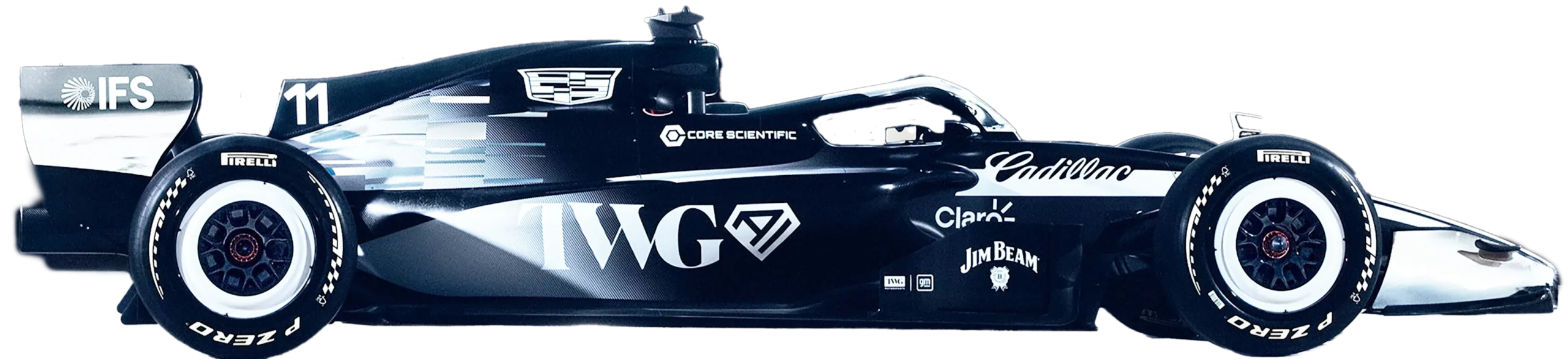
The MAC-26 chassis was shaken down at Silverstone in January 2026. At that event, the car ran in a special all-black livery featuring the names of the team's founding staff members on both sides, every person who had built the organisation from its first days was on the car when it first ran.
The race livery was revealed in a television commercial during Super Bowl LX on 8 February 2026, broadcast to an estimated 130 million viewers. A full-scale replica of the car was simultaneously unveiled at Times Square in New York City. The commercial depicted the MAC-26 being assembled on a lunar landscape and incorporated excerpts from President John F. Kennedy's 1962 address at Rice University, his speech committing the United States to landing on the Moon. "We choose to go to the Moon," Kennedy says in the original recording. The invocation of that speech, with its themes of national ambition, impossible timelines, and the obligation to do things not because they are easy but because they are hard, was direct. Towriss was explicit about the intent: "We didn't come into Formula 1 to look like every other team."
The race livery itself is asymmetrical: one side of the car is black, the other white. The team described this as a deliberate design philosophy, referencing a balance between determination and aspiration. It was the first asymmetrical livery in Formula One since the BAR 01 of 1999.
The car ran 164 laps in official pre-season testing at Barcelona in late January, completing its shakedown programme. Both drivers reported the expected issues of a new car on a new team, Bottas described "lots of problems to solve" alongside the progress made and Pérez noted sustained improvement run by run. Pre-season testing in Bahrain followed in February.
The arrival of Cadillac created the first season in which two American-licensed teams competed in Formula One simultaneously. Haas and Cadillac represent almost entirely opposite philosophies.
Haas was built on the explicit principle of minimising internal complexity: source as much as possible from Ferrari, keep headcount lean, and direct resources toward race operations rather than design. That model has sustained Haas for a decade, delivering consistent mid-field results and a peak finish of fifth in the constructors' championship in 2018. Its ceiling is debated precisely because of the depth of the Ferrari dependency, but its longevity is not.
Cadillac has been built toward full manufacturer independence from the start. The engine programme, the multiple owned facilities, the target of 1,000 staff, these are the commitments of an organisation that intends to be a works team. Towriss has said so explicitly: "I think we're great believers in the fact that we should be in charge of our own destiny and that we are a works team, we're heading to be a works team." The 2026 and 2027 Ferrari customer arrangement is the bridge to that destination, not the destination itself. From 2029, Cadillac becomes the sixth constructor to supply its own power unit to Formula One in the modern hybrid era.
The contrast extends to market positioning. Haas has rarely sought to be American in its public identity, its European base, Italian power, and midfield anonymity have largely shielded it from that framing. Cadillac has positioned American identity as central. The Super Bowl reveal, the Times Square activation, the JFK Moon speech, the MAC-26 name honouring an American champion, every major communications decision has been made with the North American market in mind. In a sport that now hosts three American Grands Prix, this is a deliberate alignment with Formula One's most significant growth audience of the past decade.
No new Formula One team has won a race in its debut season since Brawn GP in 2009. Most take years to be competitive. The three teams that entered together in 2010 , Virgin, HRT, and Lotus/Caterham, combined for three championship points across the entirety of their participation. Haas, the last new entry, finished sixth and fifth in its first two races and ended the year eighth in the constructors' standings, the best debut by any constructor since Toyota in 2002.
Cadillac enters in a regulation reset year, which in theory narrows the gap between established teams and new entrants. The 2026 regulations introduce substantial changes to power unit architecture, aerodynamic philosophy, and chassis design. Every team is building a new car to a new ruleset. Cadillac still begins without the aerodynamic database, the simulator correlation, and the decade of institutional knowledge that Ferrari, Mercedes, and Red Bull carry into the new era. The gap will be real.
The team's own stated definition of success for 2026 is not a points total. It is earning the respect of other teams, in how the garage is run, how the cars are prepared, and how the engineers present themselves in technical briefings. Symonds said in pre-season: "One thing that's really important is that we earn the respect of the other teams. That's particularly important to me because I think we deserve that respect and that doesn't just go with the car, it goes with our whole operation."
The competition for the 2029 version of this team begins now.
| Season | Constructors | Points | Notable |
|---|---|---|---|
| 2026 | TBD | TBD | Debut season; first new constructor since Haas 2016 |
Race wins: 0. Pole positions: 0. Drivers: Sergio Pérez (Mexico), Valtteri Bottas (Finland) Combined starts at debut: 527. Combined wins at debut: 16.
Last updated March 2026